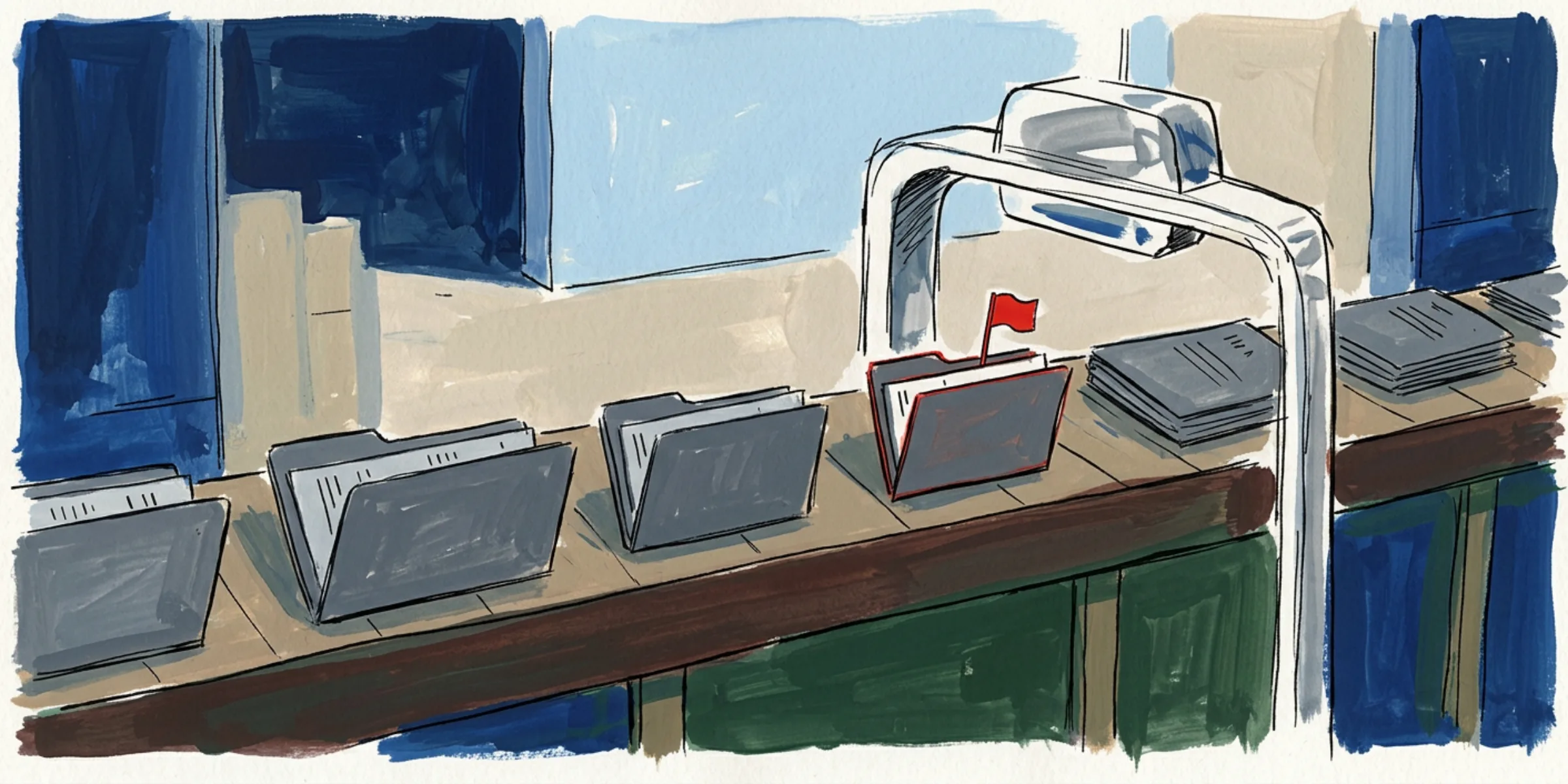
A second-level reviewer does not start with the number that's wrong. For the first several minutes on a return, they are not reading the current year at all — they are reading last year's, checking it against what actually got filed rather than what should have carried forward.
That order is not written down anywhere. No firm's manual specifies that continuity comes before sourcing, or that a full read comes before either. It is judgment a reviewer builds up over seasons, and it is the difference between thirty focused minutes finding what matters and thirty minutes spent on whatever happened to be on top of the file.
The order, in practice
Time is the constraint the order is built around. A second-level review on a return that isn't already flagged high-risk gets a fixed slice of a reviewer's day, not an open-ended one — so the sequence exists to find the cheap, structural problems before spending the expensive part of the budget on judgment calls that can't be rushed.
Last year's return, before this year's
Elections, methods, and carryforward balances — checked against what was actually filed, not what should have carried forward.
The diagnostic report
Whatever the software already flagged, cleared or explained first, so the rest of the time isn't spent re-finding what a machine already caught.
One read, front to back
The whole return, once, without touching a source document — testing whether it agrees with itself before testing whether it agrees with anything else.
What moved, and by how much
Line items that changed materially year over year, or that are large relative to the return, traced to source — not every line, the ones that earn it.
The positions that need support
Whatever depends on judgment rather than arithmetic, checked against the standard that position actually has to meet.
What's missing, not just what's wrong
A pass for the election not taken, the credit left on the table — the only step that isn't looking for an error.
Sourcing at this stage is not exhaustive. There is no time in thirty minutes to trace every figure to a document outside the software, and a first-level reviewer likely already did that once. What a second-level review adds is targeted: the lines that moved materially from last year, and the lines large enough relative to the return that an error there would matter. Everything else gets the benefit of the earlier review, not a second full trace.
Here is what that first step actually catches. A reviewer opens last year's return before this year's and notices something that doesn't belong: the client's books moved from cash to accrual mid-year, the current-year numbers already reflect it, and there is no Form 3115 anywhere in the file. The return may add up perfectly — that is not the problem. The problem is a method change that was never authorized on paper, and the two are not the same category of error. Caught in the first read, it is a conversation with the preparer before the sourcing step even starts. Caught at sign-off, it is a return pulled back after the client already believes it is ready.
That is the shape of every step before judgment: cheap to run, and only valuable if run early. The diagnostic report catches what software already knows to flag. The full read catches internal disagreement — a schedule total that does not tie to the summary line, an allocation that does not sum to the total. None of it requires expertise so much as attention, and none of it is worth doing after the harder question has already been decided.
The order is not incidental. It is the difference between finding what matters in thirty minutes and finding whatever happened to be on top of the file.
What the later checks are actually testing for
By the time a second-level reviewer reaches the positions that need judgment, the return has already survived four checks that had nothing to do with judgment at all — it agrees with itself, it agrees with its sources, and it agrees with where it came from a year ago. What is left is the narrower, harder question: does the authority behind each remaining position meet the standard it needs to. Treas. Reg. § 1.6662-4(d)(2) sets substantial authority as an objective standard — the weight of supporting authority has to be substantial relative to what argues the other way, a materially higher bar than a position merely being arguable. That test does not get faster with experience. It gets narrower, because the first four steps have already cleared away everything that was not actually a judgment call to begin with.
The five checks behind this order
This walkthrough follows the order a senior reviewer actually works in. Pernee's guide covers what each of the five checks is testing for and where automation stops.
The order is the part nobody wrote down
None of this is written down at most firms. The checklist, where one exists, lists what to check — not the sequence to check it in, or why continuity comes before sourcing. That sequencing is judgment built up over returns, seasons, and the specific ways things go wrong at this firm, in this practice area. It lives in one reviewer's head, and it leaves the building when they do — or when they are out during the two weeks a season actually needs them, and whoever is covering has to reconstruct an order from scratch, on someone else's return, at the worst possible time to be improvising.
Pernee does not reproduce that judgment. What it keeps is the reasoning behind a prior conclusion — the note explaining why a method changed, or why a position was accepted without disclosure — attached to the return line it explains, so a reviewer stepping in does not have to guess at the order their colleague would have worked in. They still decide what to check first. They just are not starting from nothing.
Make the sequence someone else's problem, not yours to remember
See how Pernee keeps the reasoning behind a prior review — not just the conclusion it landed on — where the next reviewer will find it, in time to use it.