Tax return review is the structured, independent examination a completed return receives before it is signed and filed — carried out by someone other than the person who prepared it. Its purpose is not to re-do the preparation. It is to answer a different question from the one the preparer was answering: not "did I enter this correctly?" but "is this return right, and can we sign it?"
That distinction is the whole discipline. A preparer works forward from source documents to a return. A reviewer works backward from the return to the positions it takes, asking what each one depends on and whether that dependency holds. The two are different cognitive tasks, which is why the same person doing both catches materially less than two people doing one each.
Review is a professional obligation, not a firm preference
It is tempting to treat review as a quality-control nicety — something well-run firms do and busy ones compress. The regulations governing practice before the IRS do not read that way.
Circular 230 § 10.22 requires a practitioner to exercise due diligence in preparing, approving and filing returns and other IRS submissions. Section 10.34(a) goes further and attaches consequences to signing: a practitioner may not willfully, recklessly, or through gross incompetence sign a return that the practitioner knows or reasonably should know contains a position lacking a reasonable basis. The phrase carrying the weight there is "reasonably should know" — it describes a standard of what a competent practitioner would have found, not a defence of what this one happened to notice.
IRC § 6694 puts a number on it. An understatement due to an unreasonable position exposes the preparer to a penalty of the greater of $1,000 or 50 percent of the income derived from preparing the return. Where the conduct is a willful attempt to understate liability, or a reckless or intentional disregard of rules or regulations, the exposure rises sharply — the figure below. The defence in § 6694(a) is substantial authority for the position — or, for a disclosed position, a reasonable basis.
$5,000 or 75%
The IRC § 6694(b) preparer penalty for a willful understatement or a reckless disregard of the rules — the greater of the two, charged per return, to the preparer personally
Substantial authority and reasonable basis are conclusions someone has to reach and be able to show they reached. Review is the process that produces that record. A firm with no review step has no artifact demonstrating the diligence the standard assumes.
What a reviewer is actually checking
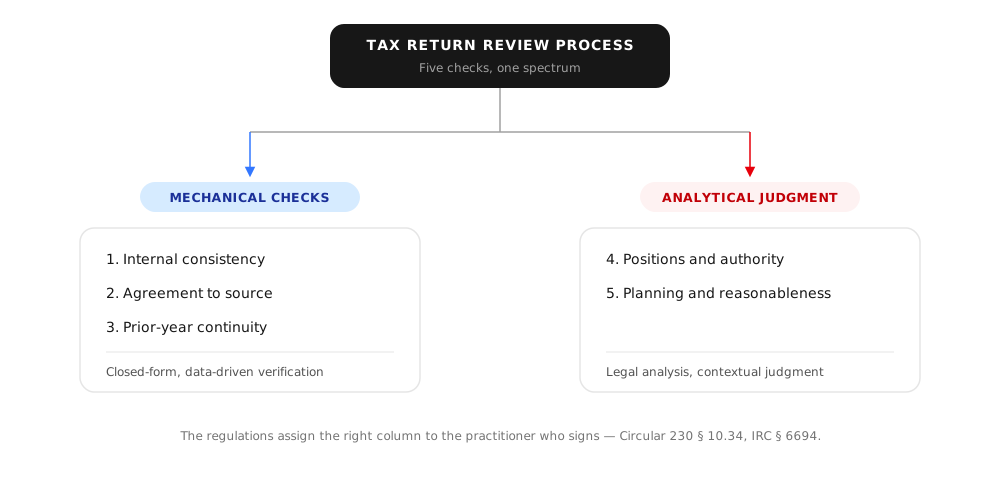
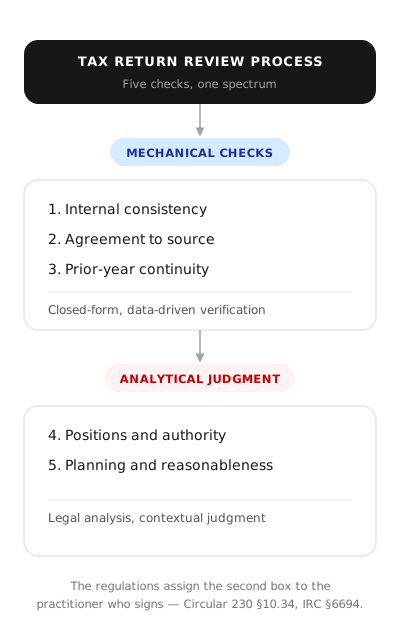
While every firm's review process varies, the checks fall into five distinct categories along a spectrum — moving from purely mechanical data verification to complex human judgment.
- Internal Consistency: verifying schedule totals, partner allocations, and a balancing balance sheet, directly within the return.
- Agreement to Source: cross-referencing values against the underlying trial balance, K-1s, payroll filings, and brokerage statements.
- Prior-Year Continuity: ensuring opening states, carryforwards, and depreciation methods match last year's filed closing state.
- Positions & Authority: evaluating the statutory and regulatory support behind any position that could face an IRS challenge.
- Planning & Reasonableness: sanity-checking the return for a missed election, a stranded credit, or a poor fit with the client's context.
Where AI fits, precisely
Map automation onto those five and the answer stops being a slogan. Categories 1 and 2 are largely mechanical: comparing numbers across a document, and comparing a document against a source. Software has been doing the first for decades through diagnostics, and the second is now genuinely tractable. Category 3 is the interesting one — comparing this year against a prior year is mechanical in form, but only if last year's conclusions were recorded somewhere a system can read, which in most firms they were not.
Categories 4 and 5 are different in kind. A position's authority is a judgment about how a rule applies to facts, and the consequence of getting it wrong lands on a named practitioner under § 10.34 and § 6694. That is not a workflow step waiting to be automated; it is the thing the regulations assign to a person.
The useful question is not whether AI can review a return. It is which of the five checks you are handing over, and whether the standard governing that check permits it.
The governing standards already handle this without needing an AI-specific rule. Section 10.22 addresses relying on work product produced by someone other than the reviewing practitioner: the practitioner is presumed to have exercised due diligence where they used reasonable care in engaging, supervising, training and evaluating the person whose work they relied on. That framing transfers cleanly. Whatever produced a draft, the reviewer owns the verification — and "the tool flagged nothing" is not a review conclusion, it is the absence of one.
Section 10.34(d) makes the parallel point about client information: a practitioner generally may rely in good faith, without verification, on information furnished by the client — but may not ignore inconsistencies or information that is incomplete on its face. Good-faith reliance with eyes open is the standard. It has never meant reliance without looking, and a tool in the chain does not change that.
It is worth noting that the AICPA's Statements on Standards for Tax Services, revised effective January 1, 2024, added standards addressing data protection and reliance on tools — an acknowledgement at the professional-standards level that tooling in the tax workflow is a subject requiring its own treatment rather than an assumed neutral.
What human-in-the-loop has to mean to be real
"Human-in-the-loop" is said often enough to have stopped meaning much. For tax review it has a testable definition: a human makes the call on anything that determines a filing position, and there is a record of them making it.
- The system proposes; the reviewer disposes. A flag is a question, not a finding, until someone answers it.
- Silence is not clearance. If a check did not run, the record should say so — an unflagged return and an unexamined return must not look identical.
- Every disposition is attributable. Who accepted this, when, and on what basis — because § 10.34 attaches to a signature, and a signature is a person.
- The reasoning survives the season. A conclusion reached this year is an input to next year's review; if it lives only in the reviewer's memory, category 3 breaks the moment that reviewer changes firms.
The failure mode to design against is not a tool being wrong. It is a tool being silently right most of the time, until the reviewer stops reading carefully — at which point the diligence standard is being met on paper and not in fact.
Why review is hard in practice
Ask experienced reviewers where their time goes and the answer is rarely the technical analysis. It is reconstruction — finding the prior-year workpaper, working out why a method was chosen, locating the email where a partner approved a treatment, re-deriving a carryforward nobody documented. The judgment is the part they are paid for and the smaller part of the hours.
That is a structural problem, not a diligence one. Preparation software carries numbers forward; it does not carry reasons forward. Review notes are treated as disposable — written to get a return out, then archived somewhere the following year's preparer will not look. So each season re-derives conclusions that were already reached, and the same review comment gets written again.
Where Pernee fits
This is where Pernee sits. It is a review-and-memory layer on top of the systems a firm already runs, keeping each review conclusion attached to the return line it belongs to, so the reviewer reaching category 3 next year finds the reasoning instead of rebuilding it. The review still belongs to the reviewer. What changes is how much of the work is remembering.
Put together, the answer holds together: review is five distinct checks, not one blended task, and only some of them are mechanical. Those are exactly the ones worth automating first — the rest stay judgment calls the regulations assign to a named practitioner, whatever produced the draft in front of them. What separates a review process that meets that standard from one that only looks like it is whether it can show its work afterward: what was checked, what a flag turned into, and who decided. That record, kept and carried forward, is the part most firms are still missing.
Ready to elevate your review process?
Make this year's review conclusions available to next year's reviewer
See how Pernee keeps review notes attached to the return lines they explain, across the tools your firm already uses.