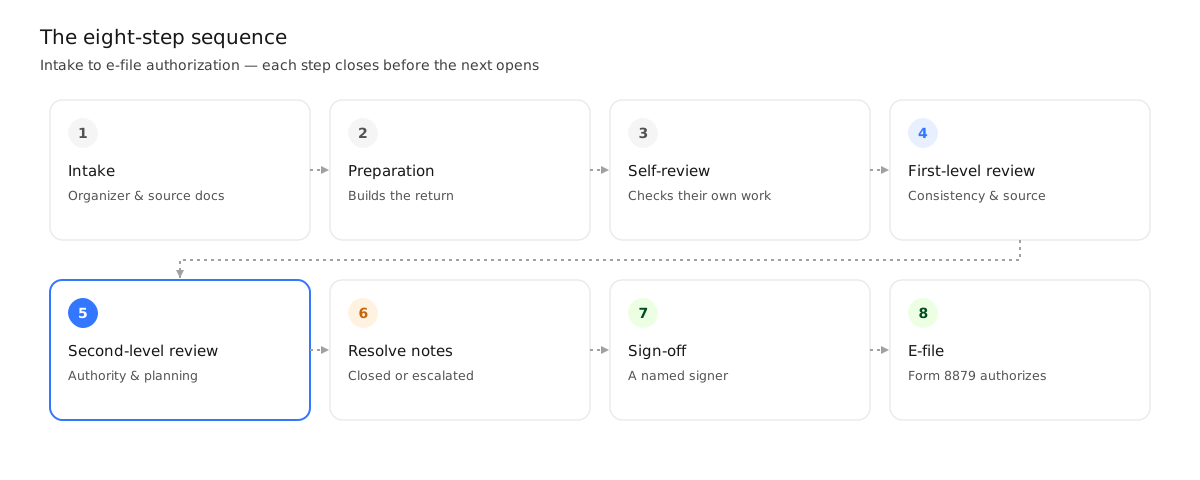
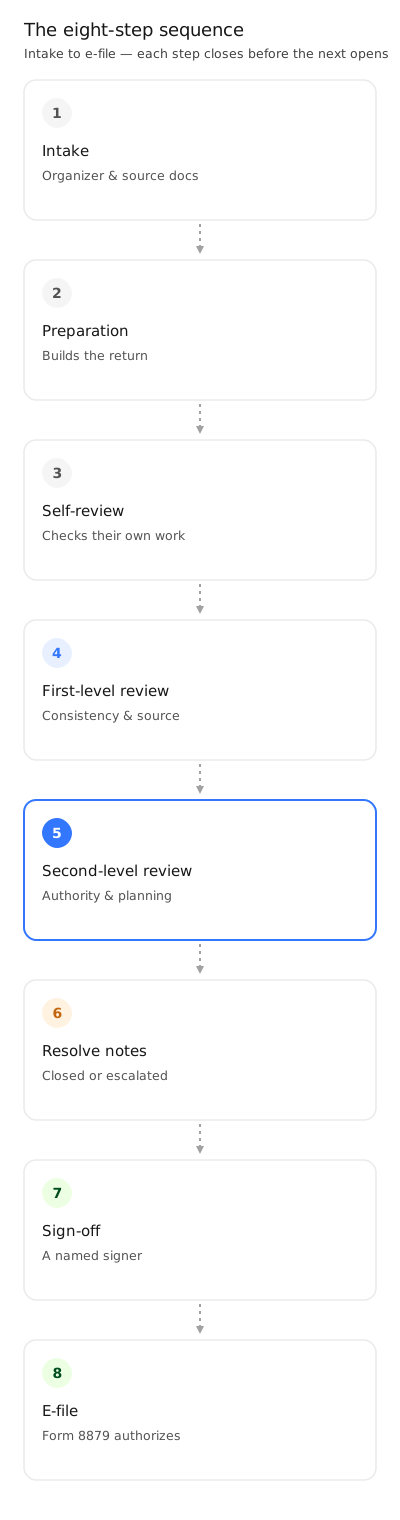
A finished return does not go straight from the preparer's desk to the client's signature. Between those two points it moves through a defined sequence — organizer intake, preparation, self-review, one or two levels of independent review, resolution of open items, sign-off, and e-file authorization. Firms describe this sequence differently, but the tax return review process itself is remarkably consistent, because it is shaped by the same due-diligence obligations at every firm, not by house style.
This is a walkthrough of that sequence step by step: who touches the return at each stage, what they are actually checking for, and where the professional-standards backbone — Circular 230 and the AICPA's quality-control framework — makes a step mandatory rather than optional.
Why the sequence exists at all
Section 10.22 of Circular 230 requires a practitioner to exercise due diligence in preparing, approving and filing a return, and in determining the correctness of representations made to a client or to the IRS. That single requirement is why review is a sequence and not an event: due diligence has to be demonstrable, and a demonstrable process is one with defined stages, not one good look at the end.
Circular 230 also addresses the reality that one person rarely does all the work. A practitioner may rely on the work product of someone else — a preparer, a paraprofessional, a subordinate — and is presumed to have exercised due diligence where reasonable care was used in engaging, training and supervising that person. For a firm's own employees, the presumption turns specifically on training and review. In other words: the review step is not a courtesy the reviewer extends to the preparer. It is the mechanism the regulation assumes exists before anyone signs.
Circular 230 governs practice before the IRS and sets mandatory conduct rules — including diligence and competency — for attorneys, CPAs and enrolled agents. A firm's internal review workflow is how that obligation gets met in practice.
That requirement carries a corollary worth stating up front: diligence that can't be shown afterward is functionally indistinguishable from diligence that didn't happen. A sign-off is evidence only for as long as the reasoning behind it stays retrievable — not just performed once, but kept somewhere the next person who needs it can actually find. That's the thread running under every step below: not just what gets checked, but whether the answer to "why" survives past the moment it was reached.
The eight steps
A review note that only says a number is correct has answered a smaller question than the one the reviewer was actually asked.
What quality control adds on top of the sequence
The AICPA frames the eight steps above as one part of a broader tax-practice quality control system, adapting the six QC elements used in accounting and auditing — leadership responsibilities for quality, relevant ethical requirements, acceptance and continuance of clients and engagements, human resources, engagement performance, and monitoring — to tax practice, with the audit-specific "independence" element replaced by "advocacy." Engagement performance is the element that governs the review sequence itself; monitoring is what tells a firm whether the sequence is actually working, as opposed to existing on paper.
The AICPA's own guidance is direct about what the earlier steps are for: before putting information on a return and signing it as preparer, the CPA has to be satisfied the appropriate professional standard has been met. Every step in the sequence above is, in effect, evidence toward that satisfaction — which is also why a firm that cannot show its review sequence happened is in a materially weaker position than one that can, independent of whether the return itself turned out to be correct.
Where the sequence actually breaks
In practice, the steps that fail are rarely preparation or first-level review — those are the most mechanical and the best supported by software. The steps that break are step 6, resolving review notes, and the continuity checks inside step 4, because both depend on information that lived in someone's memory or a prior-year email thread rather than in a system a reviewer can actually query.
Here's what that looks like on an actual file. A first-level reviewer flags a client's vehicle mileage deduction: it's up sharply from last year and nothing on the return says why. The preparer wasn't on this client last year and can't answer. Eventually someone finds the thread — a different reviewer, eleven months ago, accepted the client's explanation (a second vehicle went into service mid-year) and closed the note by replying to an email, not by writing it into the file. This year's reviewer either finds that thread or re-asks the client a question that was already answered.
Multiply that by every open item on every return, every season, and the pattern is the actual bottleneck. It's not step 4 or step 6 specifically — it's the shape of the whole sequence. Eight handoffs means eight places for context to drop rather than one, and what a given step needs is rarely in one place: it's split across the tax software, a shared drive, an old email thread, and whichever reviewer happens to remember the conversation. Ask that person on a day they're out, or after they've moved to a different book of clients, and the bottleneck isn't the review step itself — it's that nobody else can reach the answer.
Closing that gap doesn't take a ninth step in the sequence. It takes the answer to "what did we decide, and why" living somewhere other than an email thread or one reviewer's memory — which is what Pernee is: not another review step, but the place that answer lives. When this year's reviewer hits the same mileage question, or the same continuity check, they open Pernee, find what was decided and why, and meet the same diligence standard the sequence exists to prove — instead of re-asking a question that was already answered.
Give the next step in the sequence what the last one knew
See how Pernee carries a review conclusion forward from one step of the process to the next — and from this filing season into next.